
About Intersex Youth
Intersectionalities
Intersex Youth and Intersectionalities
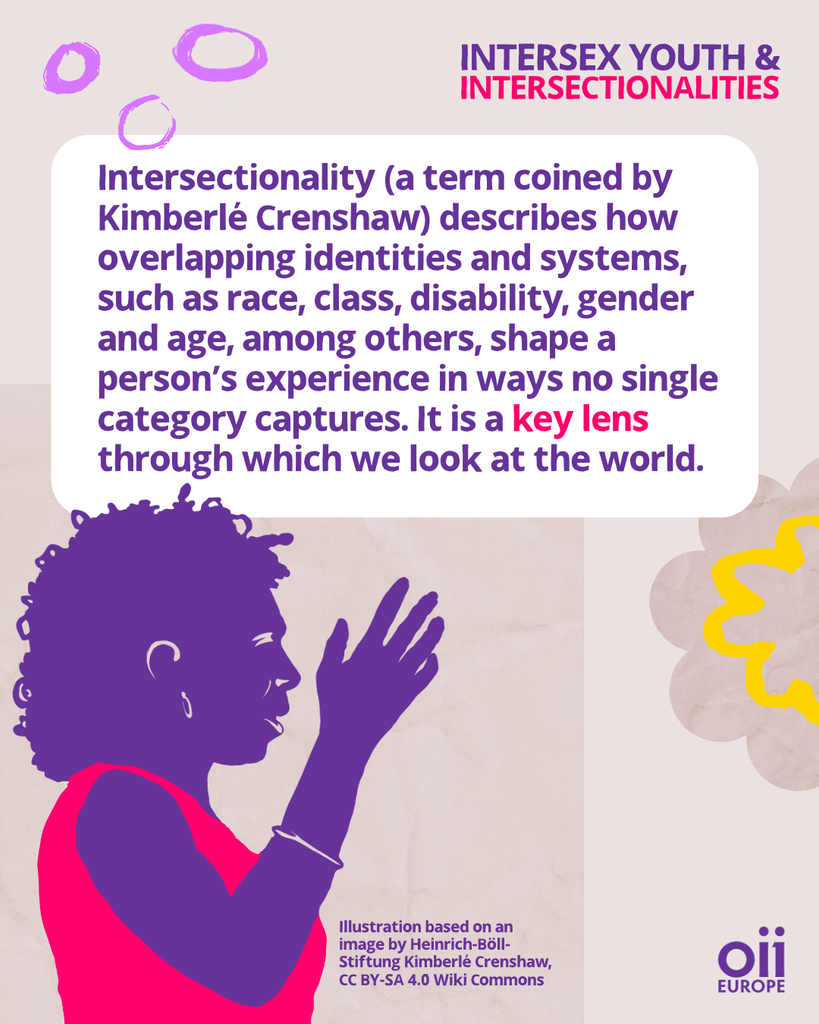
Intersectionality (a term coined by Kimberlé Crenshaw) describes how overlapping identities and systems, such as race, class, disability, gender and age, among others, shape a person’s experience in ways no single category captures.
Intersectionality is a key lens through which we look at the world.
For intersex youth, some key intersectionalities are important for us to consider when we think about their everyday lived realities.
For example the intersection of age and being intersex:
When we are young, many decisions are left up to the persons in whose care we are, and this also impacts the way that young people are often ‘talked to’ rather than listened to. This is a universal experience for all young people. Young people are also often deemed unable to consent for themselves. For intersex youth, we know this intersects very uniquely and specifically, when decisions are taken about their bodies by doctors or parents/guardians, without their free, fully-informed consent. For many intersex youth, we know that this can lead to them being forced to undergo medically unnecessary so-called ‘normalising’ interventions on their sex characteristics. It can also look like not being believed when you speak up about the way you feel in your body.
“[…] I think we have to be careful about confusing visibility with acceptance. Intersex people can be more visible while still being reduced through medical definitions, diagnosis, or stories of medical violence. So I think the next step is not simply to make people aware that we exist. It’s to make it possible for intersex people to define themselves, to be visible on their own terms.“
Arno, intersex activist from Belgium during the Youth Panel of the OII Europe Online Community Event & Public Conference 2026
We can also look at the intersection of gender identity and sexual orientation:
For intersex youth who hold intersecting identities, such as being both queer and intersex, or as being intersex and trans, the barriers multiply. Queer or trans intersex youth regularly face erasure, where for example healthcare practitioners may mistake their natural variations of sex characteristics as them being trans per se, or they might question the validity of their gender identity entirely.
For all young people, opening up about their sexuality or gender identity, can be difficult and intimidating. Many young people do not live in environments where it is necessarily safe enough to come out to their family and friends. On top of this,many intersex youth experience repeated attempts to ‘normalise’ and control their body and their sexuality throughout their lives, and therefore, coming out to family and peers as being LGBTQ, can be extra tough, compared to their endosex peers.
So too, one’s cultural beliefs, religion and geographical location all impact one’s lived experience. Cultural or faith beliefs can shape family responses, the level of stigma, and access (lack of access) to support. Racialised intersex youth may also face increased bias and discrimination in healthcare settings, due to the compounding of pathologization and racism which is unfortunately still rampant.
(Dis)ability and being intersex can also intersect in important ways. At the same time, unlike some medicalising and pathologising frameworks would rather have us believe, being intersex isn’t a disorder or a disability.
Intersex persons, like all persons, can be born with a disability or can acquire a disability during their lifetime due to illness, an accident or even environmental and social factors. Intersex persons can also acquire a disability as a direct result of medically unnecessary, non-consensual interventions on their sex characteristics (also know as intersex genital mutilation – IGM – see the box on the page about Access To Health Care ). Similarly to persons with disabilities, intersex persons’ lived experiences are also often seen through a medical model, as opposed to a social, human-rights based model.
Intersex persons with disabilities are at risk of multiple and intersectional forms of discrimination in all areas of life in the EU. According to the latest FRA LGBTI III survey (2023) data, 16% of intersex respondents reported having a disability. In the previous FRA LGBTI II survey (2019), 20.29% said they considered themselves as a “minority in terms of disability”, compared to 5.18% of all LGBTI respondents. In FRA’s latest report, “Being Intersex in the EU”, which interpreted the 2023 survey data with an intersectional lens, we can see that in a question that asked respondents about the grounds they perceived to have been the basis for discriminatory acts, 20% of intersex respondents reported their ‘disability’ as being the reason.
For intersex persons with disabilities, multiple identities and experiences intersect and are coupled with stigma and stereotyping, thereby leading to unique experiences of victimisation, marginalisation and exclusion.

SOURCES
Intersex, Disabled and Burnt Out by the Healthcare System
Article by the US-american organisation interACT – Advocates for Intersex Youth about Rainii, who is an autistic intersex person who likes to make art and talk about intersex and disability awareness. Rainii does their best to spread positivity and joy in their work and is excited to share with others!
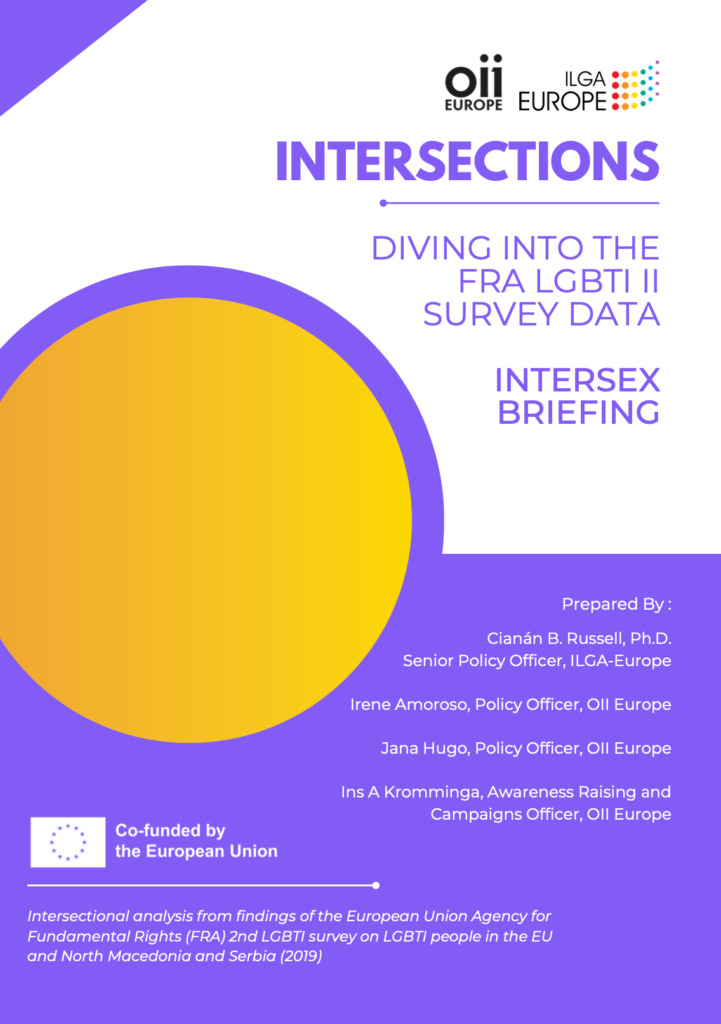
Intersections: The LGBTI II Survey – Intersex Analysis
ILGA Europe and OII Europe published a report on Intersections, the fourth of a series of reports that seek to deep-dive into the data of the European Fundamental Rights Agency (FRA) 2019 LGBTI Survey II
More on Experiences of Discrimination in School/University (from the FRA Intersections Report ILGA-Europe & OII Europe – p. 15)
“Over a quarter (36.13%) of young [intersex] respondents felt discriminated against by school or university personnel, compared to 19.51% of all LGBTI respondents. Within this age group, the share is higher for intersex people with disabilities (40.41%) and non-binary intersex respondents (43.74%).”